

What My Failed Business Taught Me About Building Wealth

By Thomas C. Corley
The best advice often comes from people who have experienced the journey themselves. Much of the advice I offer on building wealth is based on my research into the habits of wealthy people and the books I have written on the subject. But I have also learned some of my most valuable lessons the hard way: by trying, failing and starting over.
I began my career by launching four companies. One of them failed. When everything finally came crashing down, I sat in my car one morning in a park near my home and broke down in tears. I had no job prospects and no way to support my young family. It was the lowest point of my life.
Eventually, however, I managed to regain my footing. I did more than simply recover. The lessons I learned from failure ultimately helped me build and run three successful companies.
Here are the most important lessons failure taught me.
1. Choose Your Business Partners Carefully
Success becomes considerably easier when you have the right partners—and considerably harder when you do not.
Choose people who have already been through the experience and achieved results. Never enter a new venture without partners who possess genuine, practical experience in the industry.
The right partner can accelerate your progress. The wrong one can undermine the entire business.
2. Success Requires Risk and Sacrifice
You cannot become a successful entrepreneur without taking risks and making sacrifices.
The greatest sacrifice is often not money, but time—particularly the time you spend away from your family while trying to build a business.
Entrepreneurship comes with a cost, and you need to understand that cost before committing to the journey.
3. Trust Your Instincts
By instinct, I mean what is often described as the subconscious mind: the part of your brain that notices things you may not consciously recognize.
Listen to that inner voice. It may be telling you what you should pursue—or what you should avoid.
Your instincts can become particularly clear when your emotions are strong. If something feels fundamentally wrong, do not automatically dismiss that feeling.
4. Success Takes Far Longer Than You Expect
Building a successful business almost always takes longer than you initially imagine.
Entrepreneurs tend to underestimate how much time is required to develop a product, establish a customer base, generate sustainable revenue and build a reputation.
Remember what I call the Rule of Three, which I explain below.
5. The Pursuit of Success Can Be Exhausting
Entrepreneurship is rarely a smooth journey.
Things go wrong constantly, and each setback can create enormous psychological pressure. That pressure does not affect only you; it can also affect your family, relationships and business partners.
Understanding this reality can help you prepare for the emotional demands of building a company.
6. Fund Your Business Yourself When You Can
When you provide your own working capital, you retain control.
Once you become dependent on outside investors or other sources of financing, those who provide the money may gain significant influence over how the company is run.
In simple terms, whoever controls the capital often has a say in the decisions.
7. Assumptions Are Worthless Until They Are Tested
Assumptions can make you see your business through rose-colored glasses.
Many of the assumptions underlying business plans turn out to be wrong. That is why you should test every major assumption before treating it as fact.
Do not assume customers will buy, costs will remain stable or projected demand will materialize. Test those ideas in the real world.
8. The Pursuit of Success Can Be Incredibly Exciting
Entrepreneurship comes with dramatic highs and lows, and there may be far more difficult periods than triumphant ones.
But the moments when everything finally works—when you win a major client, launch successfully or see the business begin to grow—can make the struggle worthwhile.
Those moments provide the motivation to keep going.
9. Success Requires Luck and Avoiding Bad Luck
Unexpected events are an unavoidable part of building a business.
Some will work in your favor. Others will not.
To a certain extent, both success and failure lie outside your control. Timing, market conditions, unexpected opportunities and unforeseen setbacks can all have a significant impact.
Hard work matters, but luck matters too.
10. Failure Is a Humbling Experience
Failure can be emotionally devastating.
It can also create serious financial consequences, including the loss of your ability to support yourself and your family. In extreme cases, the pressure can place enormous strain on family relationships.
Failure strips away many illusions about control and success—and forces you to confront reality.
11. Success Requires Overcoming Adversity
Obstacles, setbacks, flawed assumptions, mistakes and unexpected events can bring a business to a complete standstill.
Sometimes you find a way through them. Sometimes you do not.
The entrepreneurs who ultimately succeed are often those who learn how to absorb setbacks, adapt and keep moving forward.
12. Maintain Control of Your Business
Control means more than simply being the founder. In my view, it means owning more than 50% of the company.
The person who controls the majority stake ultimately has greater influence over the company’s direction, its future and, to a significant extent, their own professional life.
Giving away control too early can leave you dependent on other people’s decisions.
13. Test Every New Idea First
Before committing yourself fully to a new venture, test the concept.
Do not pour all your time, money and energy into an idea simply because it sounds promising. Start small, validate the business model and determine whether it can produce real results.
Only then should you consider committing yourself to the venture full time.
14. Keep an Emergency Reserve
Something will almost always go wrong in a new business.
That is why entrepreneurs should maintain sufficient savings to support themselves and their families if the venture fails or takes considerably longer than expected to become profitable.
An emergency reserve gives you something invaluable: time to recover and make your next move.
15. Understand the Rule of Three
My Rule of Three is simple:
A new business will take roughly three times longer to succeed than you expect and cost approximately three times more than you initially budgeted.
At the same time, its revenues and profits may amount to only one-third of what you originally projected.
The lesson is not to abandon ambition, but to build realistic financial and time buffers into your plans.
16. Business Plans Are Not Enough
A business plan is only a set of assumptions about the future.
It cannot guarantee that customers will buy your product, that costs will remain under control or that the market will behave as expected.
Never launch a business based solely on what is written in a business plan. Validate the underlying assumptions first.
17. Protect Your Marriage and Family Life
Building a company can put enormous pressure on personal relationships.
If your marriage is already fragile, the demands of entrepreneurship can make things considerably worse. A failing relationship and a struggling startup can end up damaging each other.
A strong personal foundation can therefore be just as important as a strong business strategy.
18. Keep Your Costs as Low as Possible
Avoid building a large payroll before the business has proven itself.
Use contractors and outside specialists where appropriate, and hire full-time employees only when the business model has demonstrated that it can generate sustainable results.
You do not need an impressive office or an expensive corporate structure to build a successful company.
In the early stages, simplicity and financial discipline can be powerful advantages.
19. Stay Connected to Your Network
Building a company can consume enormous amounts of time, making it easy to lose touch with friends, former colleagues and professional contacts.
Do not let your network disappear.
Maintain those relationships even when you are busy. Your contacts can provide advice, opportunities, introductions—or even help you find your next job if your venture does not work out.
Failure Is Part of the Journey
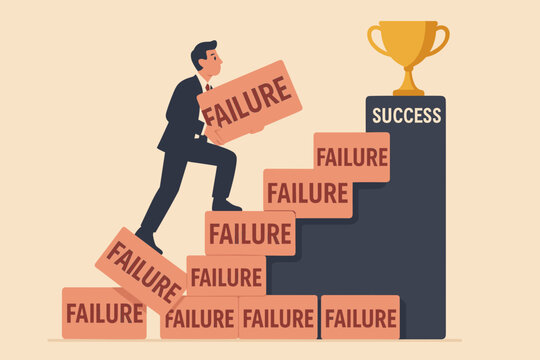
Failure can be painful, expensive and deeply personal. But it can also be one of the most valuable teachers an entrepreneur will ever have.
The key is to extract lessons from every setback rather than allowing failure to define you.
Success is rarely a straight line. It is often built through a combination of persistence, preparation, adaptability, good judgment—and, sometimes, a little luck.
The entrepreneur who understands that reality is better prepared not only to survive failure, but to use it as a stepping stone toward the next opportunity.
Related Topics:
6 Essential Traits of Successful Entrepreneurs
The Garage Myth: What Really Builds the World’s Most Successful Startups
Reed Hastings: How Failure Became the Fuel Behind Netflix’s Global Rise